

The Aegean Table
A Culinary Tour Along the Aegean with Oldways Culinaria


After a somewhat chaotic morning, I finally sank into a flimsy plastic chair with a full plate balanced on my tired legs. We were wrapping up a week of touring through the Aegean with Oldways Culinaria, ending our final day in my husband’s family village, where we’d spent the afternoon feasting on a village meal prepared by few of our aunties. Once I’d guided our guests through the spread and made sure everyone was settled, my attention locked onto one thing: the sarma.
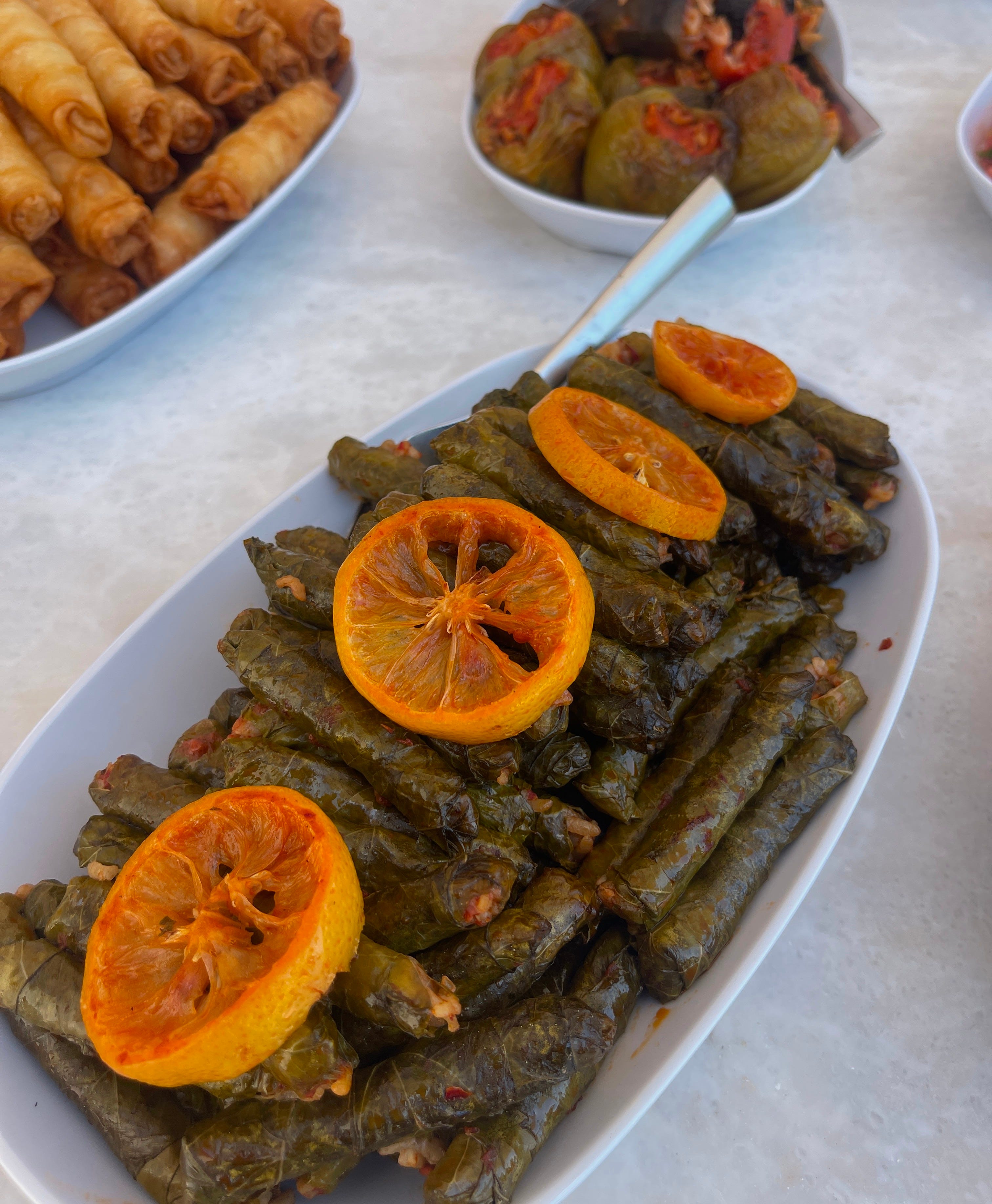
Sarma is always my priority. Specifically Aegean style and more specifically the version made by my husband’s mother and aunt: no meat, rolled impossibly thin, no wider than a pinky finger. With one hand full of the next sarma in queue and the other wrapped around a just-popped ice-cold sade soda (mineral water), I was exactly where I was meant to be.
As I ate, I kept thinking about how this one small thing, a grape leaf rolled around rice and herbs, carries more history than most textbooks bother to include. Cross into Greece and it becomes dolmades. Change the region and the filling shifts with whatever the land gives. The name changes. The proportions shift. The soul stays put. That quiet stubbornness was the thread running through the entire trip, which took us between Çeşme, Urla, İzmir and Chios, Greece, cities all shaped by the movement of people across man-made borders.
This wasn’t purely a professional trip for me. I joined as one of the culinary experts but the journey traced the very history my husband’s family carries. The question I kept returning to: when people are forced to leave, what happens to the food they take with them? What happens to the food left behind?

Thessaloniki to a Village Outside Ephesus
My husband’s grandfather was a Turkish farmer expelled from Greece in 1923, one of nearly half a million Turkish Muslims forced to leave. The reverse was also devastating: roughly 1.5 million Greeks living in what is now Turkey were uprooted in the same decree, many losing family members in the chaos of displacement.
The Lausanne Convention, signed on January 30, 1923, concluded the Turkish War of Independence, ended the Greco-Turkish War and drew new borders between Turkey, Greece and their neighbors. One of its most consequential results was a compulsory population exchange, a forced relocation of Greek Orthodox Christians living in Turkey and Muslims living in Greece. It was an order and it left wounds that haven’t fully healed.
My husband’s family had been living in Thessaloniki. They left with almost no time to prepare. When they arrived in Turkey the struggle was immediate: unfamiliar crops, foreign land and everything they’d known how to grow and cook had to be reimagined from scratch. Eventually they found their footing. They settled near the ruins of the ancient city of Ephesus, founded a village and planted roots that remain a century later.
What I keep returning to, imagining that upheaval, is the particular disorientation of things being almost right. The Aegean climate, the olive trees, the wild herbs, so much of it would have looked and smelled like home. But it wasn’t home. And to this day you can see that paradox in the food: the same ingredients, the same instincts, living on opposite sides of a line someone else drew.
Traveling with People Who Ooze Curiosity
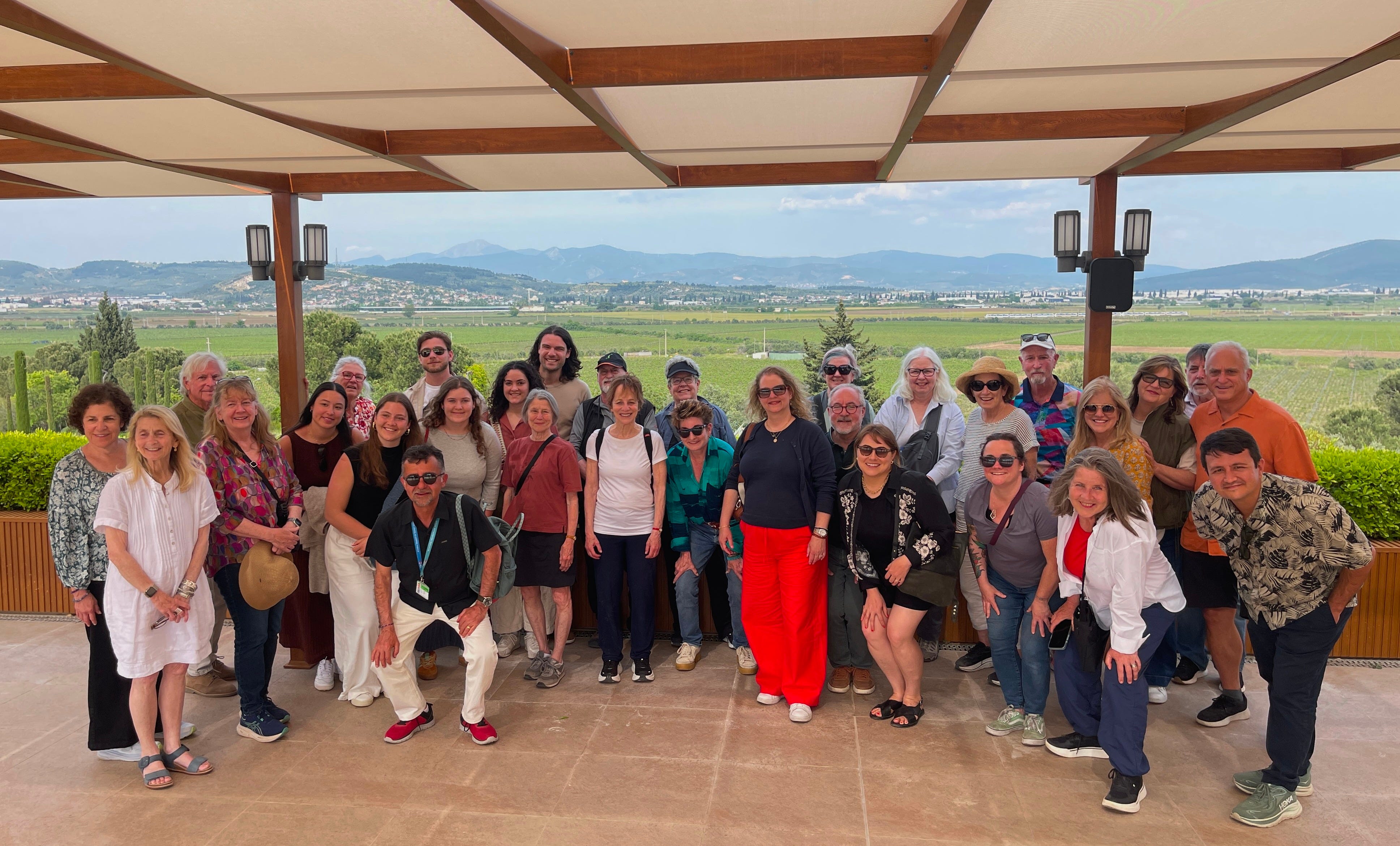
This was my second culinary trip with Oldways and I’ll say it plainly: the people make it. Both times the groups have been extraordinary and that’s no accident. The kind of traveler drawn to an Oldways Culinaria arrives already asking questions. That curiosity is no accident. Under the leadership of Sara Baer-Sinnott, Oldways has stayed true to its mission of treating food traditions as living heritage rather than artifacts behind glass. When that’s the premise, a certain kind of curious, hungry person self-selects.


This group was exceptional. We had Greeks, Armenians, political science professors, doctors, chefs, engineers, dieticians and my mom (!) among others and the conversations reflected that range. Everyone brought their own frameworks and personal histories to the table. It felt less like a tour and more like a traveling classroom. Having a Greek couple in the group added something I hadn’t anticipated. They weren’t simply interested in this history: they were woven into it and their presence deepened every conversation about displacement, memory and food of the Aegean.
The Ingredients That Didn’t Get the Memo About Borders


Chef Ana Sortun, the Boston-based chef behind Oleana, Sofra and Sarma, has spent her career making the flavors of the eastern Mediterranean feel alive. She led us through the pantry of the Aegean, or Ege as the Turks call it. And what a pantry it is! Maraş pepper, sumac, dried mint, nigella seeds, wild thyme and oregano. Silky olive oil. Tart pomegranate molasses. Tomato and pepper paste thick enough to stand a spoon in. Fava beans, erişte, artichokes, buffalo-milk yogurt strained to a dense tangy cream, crumbly goat’s milk cheeses, purslane and sea beans.
Some of these ingredients are unique to Turkey but most were just as abundant on the Greek side of the Aegean, prepared with slight but telling variations. A different hand, a different name, the same soul.
We wandered markets in Alaçatı and Urla where the produce glows. We visited artichoke farms and pomegranate orchards. Slurped on freshly pressed olive oil that tasted unmistakably of this place: peppery and grassy. On Chios, we spent time at the mastic museum, which felt like a love letter to one of the most magical ingredients in the region. Mastic may be more associated with Greece but Turkey has long folded it into ice cream, puddings and pastries. A good ingredient finds its way.
Throughout the trip I kept finding myself beside the Greek couple after meals, comparing notes. What do you call this? How do you make yours? The Turkish and Greek names were nearly always close enough to touch, one letter off, one syllable apart. We laughed every time, not because it was shocking but because it kept confirming something neither of us needed to say out loud.
Recipes Are Just Memory Written Down


We cooked everywhere. A teaching kitchen at Ege University. A village courtyard. Beside a farmhouse. At a wooden table dusted with flour. Chef Ana Sortun and Chef María José (MJ) Cordova walked us through technique and flavor, shining a light on the fava bean, the grape leaf, the local İzmir köfte and everything the Aegean produces with such casual abundance. An artichoke farmer got his hands dirty alongside us, showing how to clean and process a bayrampaşa artichoke the way it deserves. On the Greek side, a cook and businesswoman demonstrated spoon sweets, those slow-simmered preserved fruits that are essentially patience in a bottle.


A restaurant cook stretched and layered katmer until it was translucent and perfect. Then came the Turkish women of a small village of Germiyan, making sourdough and kopanisti cheese the way their mothers did. And finally aunties from our family village made gözleme side-by-side with trip participants, everyone a little clumsy, everyone laughing, everyone learning something.


What ran through all of it was the same humble approach: use what the land gives you and use all of it. Foraged herbs. The whole fruit. The whey left over from the cheese. Nothing wasted, nothing rushed. This is slow-food culture not as a trend or a label but as a deeply ingrained value. We felt it on the Turkish side of the Aegean. We felt it on the Greek side too.
My First Time in Greece
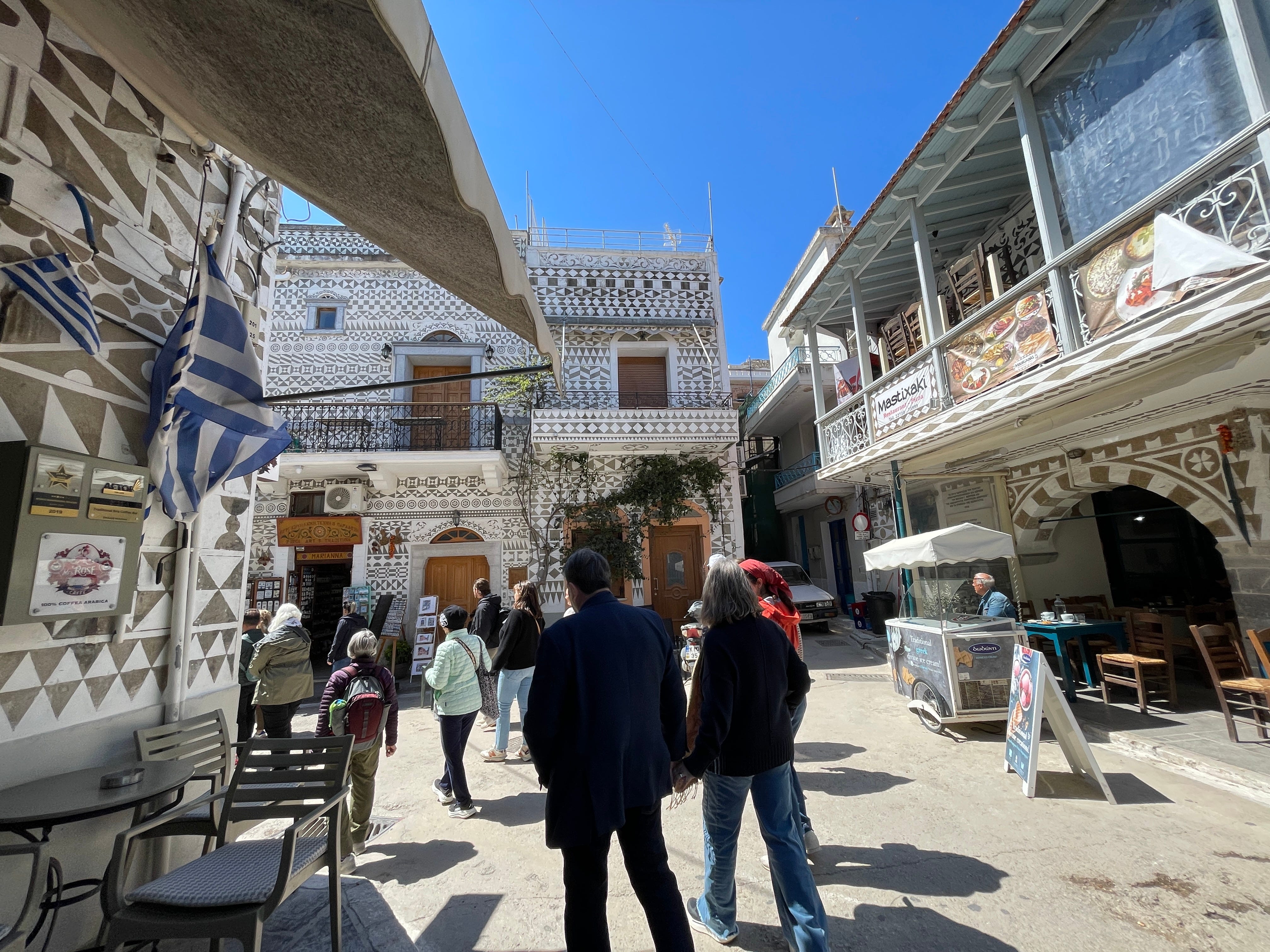
I have spent considerable time in Turkey since 2010, especially in the Aegean region, but this was my first time in Greece. As we boarded the ferry I kept thinking, despite the beautiful choppy waves that day, about how frightening this crossing must have been for those forced to take it in 1923. The ferry to Chios is geographically short but it held a lot of weight. I crossed west toward Greece while my husband’s family, a century ago, crossed east away from it.
Chios is beautiful and only 20 kilometers away. At first I felt stripped of everything I’d built up on the Turkish side: my Turkish was useless, my familiarity gone. But then the food started doing what food always does. It made things recognizable again. After learning about mastic and spoon sweets we settled into a cozy restaurant and drank Greek ouzo, which tasted remarkably like Turkish rakı. Of course it did.


If You Want to Go Deeper
As you know, history tends to draw clean lines around messy human things. Borders get agreed upon, populations get moved, wars get named and dated. But food doesn’t negotiate treaties; it just travels with whoever is carrying it.
If you want to go deeper into the history of the Greek-Turkish Population Exchange of 1923, check out Bruce Clark’s Twice a Stranger. This is where I’d send anyone who wants to understand the 1923 exchange beyond the dates and decrees. For something more visual, Dedemin İnsanları (My Grandfather’s People) is a film that follows this exact displacement through the lens of family memory.
If you ever get the chance to eat your way through both sides of the Aegean in the same trip, just do it. Order the similar dishes on both sides of the water and pay attention to the moment something feels familiar before your brain has caught up to why.
Love this piece! It makes me think of how baklava is claimed by a number of countries, but baklava has existed long before any of those borders did.
It’s wild how food can carry memory more faithfully than history books sometimes do. Curious if writing this changed the way you think about “ownership” of regional dishes across Greece and Turkey?